




Alberta’s Employment Standards Code outlines 10 types of job-protected leave of absence in Alberta for personal, family, and health-related situations. Most leaves require you to have worked for at least 90 days with the same employer. However, the rules for eligibility and the documents needed can vary depending on the type of leave.
These leaves guarantee the right to return to the same or an equivalent position. Employees are also considered continuously employed when calculating years of service. This guide is part of our series on Leave of Absence in Canada, explaining each leave type, who qualifies, and how your job remains protected during your absence.
What are the Types of Job-Protected Leave of Absence in Alberta?
Alberta’s Employment Standards Code gives eligible employees access to 10 categories of unpaid, job-protected leave, each tied to a specific life event or family circumstance.
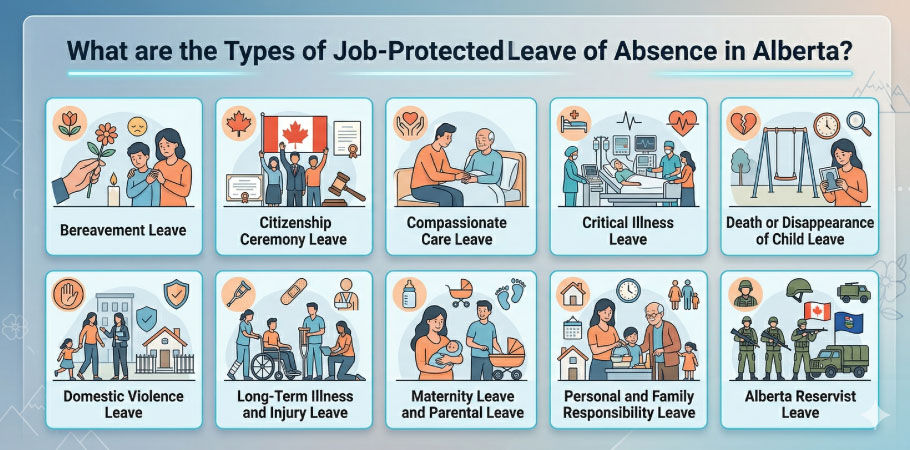
The following table summarizes each leave type, its maximum duration, and whether a medical certificate is required.
| Leave Type | Maximum Duration | Medical Certificate Required |
| Bereavement | 3 days per calendar year | No |
| Citizenship ceremony | Half-day | No |
| Compassionate care | 27 weeks | Yes |
| Critical illness | 36 weeks (child) or 16 weeks (adult) | Yes |
| Death or disappearance of a child | 52 weeks (disappearance) or 104 weeks (death) | No (verification required) |
| Domestic violence | 10 days per calendar year | No |
| Long-term illness and injury | 27 weeks per calendar year | Yes |
| Maternity and parental | 16 weeks + up to 62 weeks | May be required |
| Personal and family responsibility | 5 days per calendar year | No |
| Reservist | As needed for deployment or training | No |
All leaves are unpaid, but in some cases, income support may be available from Employment Insurance.
Bereavement Leave in Alberta
Alberta Bereavement leave allows employees to take time off to mourn or attend to matters related to a family member’s death.
To qualify for bereavement leave in Alberta:
- Employees must have worked for the same employer for at least 90 days.
- The leave can be taken upon the death of an immediate or extended family member.
Employers must grant eligible employees their bereavement leave and provide them with their same or equivalent job when they return.
Length of Bereavement Leave in Alberta
Eligible employees may take up to 3 days of unpaid bereavement leave per calendar year. Any unused days cannot be carried over.
Notice Requirements
Employees must inform their employer as soon as reasonably possible before taking bereavement leave. Although employers may request documentation, it is not required by law. (Source)
Citizenship Ceremony Leave Alberta
This leave allows employees to attend their Canadian citizenship ceremony.
The eligibility criteria for the citizenship ceremony in Alberta are:
- Employees must have worked for the same employer for at least 90 days.
- One unpaid half-day off is permitted to attend the ceremony.
Employers must grant the leave to eligible employees and reinstate them in their same or comparable jobs afterwards.
Length of Citizenship Ceremony Leave in Alberta
Eligible employees are entitled to one half-day (up to 4 hours) of unpaid leave to attend their citizenship ceremony.
Notice Requirements
Employees should provide as much notice as reasonably possible to their employer before taking citizenship ceremony leave. (Source)
Alberta Compassionate Care Leave
This allows employees to take extended time off work to provide end-of-life care for a gravely ill family member.
The eligibility criteria to qualify for compassionate care leave in Alberta are:
- Employees must have completed 90 days of employment with the same employer.
- They must be caring for a family member at significant risk of death within 26 weeks, as confirmed by a medical certificate.
Up to 27 weeks of unpaid leave are available, with job protection, for eligible employees.
Length of Compassionate Care Leave in Alberta
Compassionate care leave may be taken in one continuous period or in multiple periods, provided that each period of leave is at least one week in duration.
Notice Requirements
Employees must give at least 2 weeks’ written notice of their leave, along with a medical certificate confirming the family member’s grave illness. For leaves commencing sooner, notice should be provided as soon as possible. One week’s notice is required to end the leave early. (Source)
EI Compassionate Care
Employees taking compassionate care leave may also be eligible for federal Employment Insurance (EI) compassionate care benefits, which are administered by the Government of Canada and are separate from Alberta employment standards leave entitlements.
To qualify for EI compassionate care benefits, applicants must generally have at least 600 insured hours of work in the previous 52 weeks.
As of 2026, EI compassionate care benefits provide 55% of the claimant’s average weekly insurable earnings, up to a maximum of $729 per week. (Source)
EI benefit amounts are indexed annually and may change from year to year. Employees should confirm the current maximum benefit rate at the time of application through official Government of Canada sources.
Alberta Critical Illness Leave
This provides job protection for employees caring for critically ill or injured family members.
To qualify for critical illness leave in Alberta:
- The same employer must have employed employees for at least 90 days.
- They must be caring for a critically ill or injured child, parent, spouse, or other defined family member.
Eligible employees can take up to 36 weeks of leave without pay or benefits for a critically ill child and up to 16 weeks for a critically ill adult, unless stated otherwise under an employment contract.
Length of Critical Illness Leave in Alberta
- Up to 36 weeks of leave can be taken to care for a critically ill child under 18 years of age.
- Up to 16 weeks of leave can be taken to care for a critically ill adult family member.
The leave may be taken in periods of at least 1 week at a time.
Notice Requirements
Employees must provide their employer with a medical certificate confirming the critical illness or injury, and give at least 2 weeks’ written notice of the leave if possible. One week’s notice is required to end the leave early. (Source)
Alberta Death or Disappearance of Child Leave
This leave supports parents dealing with the unthinkable loss of a missing or deceased child due to a probable crime.
To be eligible for this leave:
- Employees must have been employed by the same employer for at least 90 days.
- It must be probable that the death or disappearance of an employee’s child under 18 years of age was the result of a crime.
Eligible employees can take up to 52 weeks of leave if their child has disappeared or up to 104 weeks if their child has died without pay or benefits, unless stated otherwise under an employment contract.
Length of Death or Disappearance of Child Leave in Alberta
- Up to 52 weeks of leave if an employee’s child disappears.
- Up to 104 weeks of leave if an employee’s child dies.
Notice Requirements
Employees must provide their employer with reasonable verification that they are entitled to the leave as soon as possible. Written notice should also be provided with the estimated return to work date. One week’s notice is required to end the leave early. (Source)
Alberta Domestic Violence Leave
This leave supports employees dealing with domestic violence. To qualify for domestic violence leave in Alberta:
- Employees must have completed 90 days of employment with the same employer.
- They, their dependent child, or another protected household member must have experienced domestic violence.
Eligible employees can take up to 10 days of unpaid domestic violence leave per calendar year without risk of losing their jobs.
Length of Domestic Violence Leave in Alberta
Eligible employees can take up to 10 days of domestic violence leave each calendar year. Unused days cannot be carried over.
Notice Requirements
Employees must notify their employer as soon as reasonably possible before taking domestic violence leave. Supporting documentation is not required. (Source)
Alberta Long-Term Illness and Injury Leave
This provides extended leave for employees unable to work due to personal illness, injury, or quarantine.
To qualify for long-term illness and injury leave in Alberta:
- Employees must have completed 90 days of employment with the same employer.
- They must provide a medical certificate confirming they require leave due to illness, injury, or quarantine.
Eligible employees are entitled to up to 27 weeks of unpaid, job-protected leave per calendar year, effective January 1, 2026.
This leave may be taken in one continuous period or intermittently, if supported by medical documentation.
Employees must provide their employer with a medical certificate and give as much notice as possible of when they need to begin their leave. One week’s notice is required to end a leave early. (Source)
Alberta Maternity Leave and Parental Leave
These leaves provide new and expectant mothers and fathers with extended time off around the birth or adoption of a child.
The eligibility criteria are:
- Employees must have worked for the same employer for at least 90 days.
- Maternity leave is available to birth mothers.
- Parental leave is available to new parents, including adoptive parents.
Eligible employees can take up to 16 weeks of maternity leave and 62 weeks of parental leave without pay or benefits unless stated otherwise under an employment contract.
Length of Maternity and Parental Leave in Alberta
- 16 weeks of maternity leave for birth mothers.
- 62 weeks of parental leave for new parents, including adoptive parents, which can be shared.
Maternity leave generally begins up to 13 weeks prior to the estimated due date and must last at least 6 weeks after the birth unless otherwise approved. Parental leave can begin after the birth or adoption and must be completed within 78 weeks.
Notice Requirements
Employees must give their employer at least 6 weeks’ written notice before beginning maternity or parental leave, unless an urgent situation prevents doing so. A four-week notice is required before ending a leave early. (Source)
Alberta Personal and Family Responsibility Leave
This leave provides employees with the flexibility to attend to health matters or family responsibilities. To be eligible for this leave:
- Employees must have completed 90 days of employment with the same employer.
- Up to 5 days of unpaid leave per calendar year are available.
Length of Personal and Family Responsibility Leave in Alberta
Eligible employees can take up to 5 days of personal and family responsibility leave each calendar year. Unused days cannot be carried forward.
Notice Requirements
Employees should notify their employer as soon as reasonably possible when needing to take personal and family responsibility leave. Supporting documentation is not required by law. (Source)
Alberta Reservist Leave
This provides time off for military reserve force training or operational duties. The eligibility criteria are:
- Employees must have worked for the same employer for at least 12 consecutive weeks.
- They must be a military reservist being deployed on operations or training.
Eligible reservists can take unpaid time off as required for training or operations, with job protection.
Length of Reservist Leave in Alberta
Reservist employees can take leave for the entire duration of their military deployment, training, or related activities. There is no maximum period.
Notice Requirements
Employees should provide at least 4 weeks’ written notice of upcoming reservist leave, when possible. If the deployment is urgent, notice should be provided as soon as reasonably possible. (Source)
Who Is Eligible for Job-Protected Leave
Most job-protected leaves in Alberta require at least 90 days of employment with the same employer. This applies to bereavement, personal and family responsibility, long-term illness and injury, compassionate care, critical illness, maternity and parental, domestic violence, citizenship ceremony, and the death or disappearance of a child.
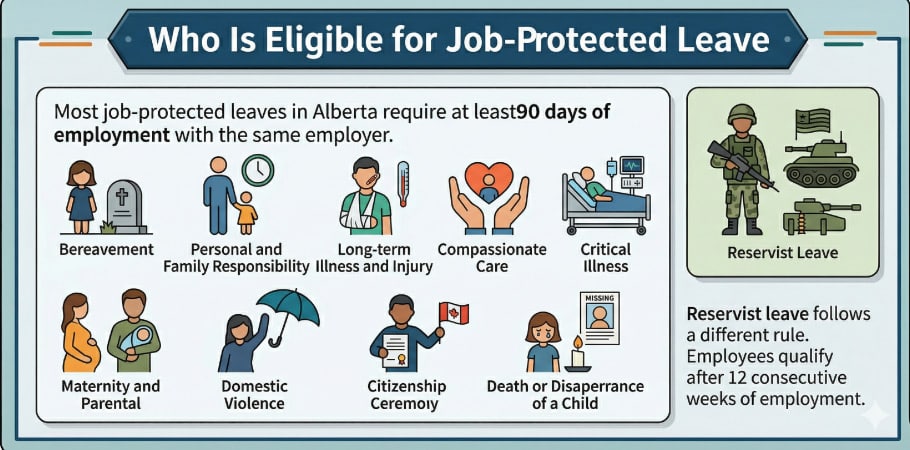
Reservist leave follows a different rule. Employees qualify after 12 consecutive weeks of employment.
Once eligibility is met, employees receive the full statutory entitlement immediately. Leave time does not accrue, and the amount of leave is not prorated based on length of service.
Employers may allow time off before the eligibility threshold is met. However, job-protection rights under Alberta employment standards only apply once the statutory requirement is satisfied.
Your Reinstatement and Job-Protection Rights
Employees returning from a job-protected leave must be reinstated to the same position or a comparable one with the same wages, benefits, and core responsibilities. Employers cannot reduce hours, demote employees, or change duties because leave was taken.
Employers are also prohibited from terminating or penalizing employees for taking or planning to take a protected leave. This protection applies from the time notice is provided until the employee returns to work.
Employment is considered continuous during the leave period. Seniority, length of service, and eligibility for benefits tied to service remain uninterrupted.
If the original position no longer exists for legitimate business reasons unrelated to the leave, the employer must provide a comparable position.
Employees who believe their rights were violated may file a complaint with Employment Standards. Complaints must generally be submitted within six months of the alleged violation.
Want to learn more about leaves of absence across Canada? See our guides covering key details for employees needing time off work in other provinces:
- Leave of Absence in British Columbia
- Leave of Absence in Ontario
- Leave of Absence in New Brunswick
- Leave of Absence in Quebec
By understanding each leave type, eligibility requirements, and how job protection works, both employees and employers can better plan time away from work. Employees can take time off when needed without risking their livelihood, while employers maintain productivity and retention.
Staying up-to-date on evolving employment laws and standards is advisable for employers. Those needing assistance can consult resources like the Alberta Employment Standards Contact Centre or seek guidance from employment law experts.
Frequently Asked Questions About Leave of Absence in Alberta
[rank_math_rich_snippet id=”s-bf9102c0-f23d-4c81-a7d5-523ee4e16fab”]
