

[rank_math_breadcrumb]
Employment Insurance in Canada: Benefits, Monthly Payments & Premium Rates
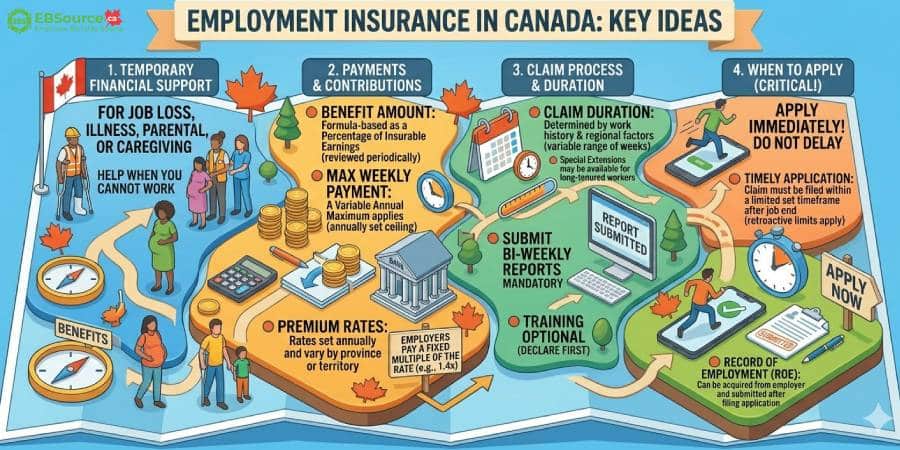
Employment Insurance is a Canadian federal program that offers temporary financial help to workers who lose their jobs or cannot work due to illness, pregnancy, or caregiving. Most EI benefits provide a basic weekly payment of 55% of your average qualifying earnings, up to a limit. However, this does not apply to all benefits.
To receive these employee benefits, both employees and employers must contribute to the program. Employees will pay $1.63 for every $100 earned, while employers pay 1.4 times that amount in 2026. Note that in Quebec, the EI rates are lower because the province has its own parental benefits system.
If you are unemployed, expecting a child, or caring for a sick family member, it’s essential to understand the benefits available, how payments work, the contribution rates, and the necessary steps after your claim is approved to receive the support you deserve.
What is Employment Insurance in Canada?
Employment Insurance (EI) is a federal program that provides temporary income support to workers who lose their jobs or are unable to work due to specific life events. These events include illness, pregnancy, caring for a newborn or newly adopted child, attending to a critically ill or injured person, and providing care for a family member who is seriously ill with a significant risk of death.
It is funded jointly by payroll premiums from both employees and employers. Each year, the program supports millions of Canadian workers and is a vital part of the country’s social safety net.
The Canada Employment Insurance Commission (CEIC) oversees the EI program and is responsible for setting the annual EI premium rate. Service Canada manages the program daily, including processing claims, issuing benefit payments, responding to inquiries, and preventing and detecting fraud.
What Types of Employment Insurance Benefits are There?
EI provides various benefits in 6 main categories: regular benefits, sickness benefits, maternity/parental benefits, caregiving benefits, fishing benefits, and benefits for self-employed individuals. Each type is associated with a specific life event and has different eligibility requirements and maximum durations. Thus, to successfully file a claim, it is important to understand which benefit type applies to your situation.
Here are six key types of benefits:
EI regular benefits provide temporary income to workers who lose their jobs for reasons beyond their control, such as layoffs or contract terminations. Workers can receive benefits for 14 to 45 weeks, depending on their work history and local unemployment rates.
EI sickness benefits assist workers who cannot work due to illness, injury, or quarantine. For claims made after December 18, 2022, the duration of these benefits has been extended from 15 to 26 weeks.
EI maternity and parental benefits support eligible parents who need to take time off work after the birth or adoption of a child. As the name suggests, it includes maternity benefits and parental benefits with standard and extended options.
EI caregiving benefits cover two specific situations: caring for a critically ill or injured person and providing end-of-life care for a seriously ill family member who has a significant risk of death. There are 3 small benefit categories under this program: compassionate care benefits, family benefits for children, and family benefits for adults.
Fishing benefits are designed to offer income support to self-employed fishers who have contributed to EI premiums but are unable to work due to circumstances beyond their control within the fishing industry.
Benefits for self-employed people: Self-employed workers, excluding fishers, can choose to join EI through a voluntary agreement. This lets them access special benefits like sickness, maternity, parental, and caregiving benefits. However, they are not eligible for regular EI benefits.
How Much Does Employment Insurance Pay A Month?
For most people, the basic rate for calculating Employment Insurance benefits is 55% of their average insurable weekly earnings. As of January 1, 2026, the maximum yearly insurable earnings are set at $68,900, which translates to a maximum weekly benefit of $729. However, the actual amount a person gets can differ based on their earnings, location, and tenure.
Note: Insurable earnings consist of various types of employment compensation, including wages, tips, bonuses, and commissions, as determined by the Canada Revenue Agency.
What is the Duration of EI Benefits?
For regular benefits, the number of weeks you can receive usually ranges from 14 to 45, depending on local unemployment rates and hours worked. Other EI benefits have set limits: up to 26 weeks for sickness benefits, up to 15 weeks for maternity benefits, up to 40 weeks for shared standard parental leave, or up to 69 weeks for shared extended parental leave. Also, caregiving benefits can be received for up to 35, 15, or 26 weeks, depending on the situation.
The exact amount depends on the unemployment rate in your region at the time you file your claim and the number of insurable hours you have accumulated in the last 52 weeks or since your last claim, whichever period is shorter. These two factors work together to establish your maximum number of payable weeks, and both are fixed at the time you file your claim.
In addition, under a temporary measure, eligible long-tenured workers may receive an additional 20 weeks of regular benefits, bringing the total to 65 weeks. This extended measure applies to claims made on or after June 15, 2025, and will remain in effect until October 10, 2026.
To qualify, you must have received less than 36 weeks of regular or fishing benefits in the past 3 years and have paid at least 30% of the yearly maximum EI premiums for 7 of the last 10 years. Check the Temporary EI Measures page for the latest eligibility details.
How are EI Benefit Amounts Calculated?
Service Canada calculates your benefit rate using the “best weeks” method to identify your highest-earning weeks during the qualifying period. It adds the insurable earnings from those weeks, divides the total by the number of best weeks used, and then multiplies the result by 55%.
Please see the formula below for clarification:
Weekly EI benefit amount = (Total Insurable Earnings from Best Weeks : Number of Best Weeks) × 55%
The number of best weeks considered can range from 14 to 22, depending on the unemployment rate in your region. Areas with higher unemployment use the best 14 weeks, while those with lower unemployment use the best 22 weeks. The reason why the lower divisor in high-unemployment regions can lead to a higher weekly benefit is that it excludes lower-earning weeks from the calculation.
Once your weekly benefit rate is established, it will remain the same for the duration of your claim. To find the unemployment rate in your region, you can visit the EI Program Characteristics page.
What are the EI Premium Rates?
Starting in 2026, employees in Canada will pay an EI premium of $1.63 for every $100 of insurable earnings, up to $68,900, whereas employers will pay 1.4 times the employee rate. These contributions determine how much is taken from each paycheck and set the maximum benefit if someone files a claim.
In Quebec, there is an important distinction regarding workers’ benefits: Quebec manages its own maternity, parental, and adoption benefits through the QPIP. As a result, employees and employers in Quebec pay a lower EI premium rate, since maternity and parental coverage are handled separately at the provincial level. Workers in Quebec who need maternity or parental benefits must apply through QPIP instead of through EI.
What is the Tax Treatment for EI Benefits?
Employment Insurance benefits are considered taxable income, regardless of the type of benefit received. Federal and provincial or territorial taxes are automatically deducted from each payment, and the total amount of benefits you received during the year will be reported on a T4E tax slip when you file your income taxes.
There is one thing to note that EI benefits are taxable in the year they are paid, not in the year the claim begins. For example, if a claim starts in December but the first payment is received in January, that payment will count as income for the new calendar year.
In addition, first-time claimants also benefit from specific protections. If someone received less than a week of regular EI benefits in the past ten years, they will not have to pay back any benefits, even if their income is high. However, this exemption can only be used once, so if they claim EI again later, the usual repayment rules apply.

What Happens After Employment Insurance is Done?
Once approved, you will need to serve a one-week unpaid waiting period before payments begin and then complete bi-weekly reports and declare any earnings in order to continue receiving benefits. Failing to submit a report or not declaring income can lead to overpayments, penalties, or even the loss of benefits. Additionally, you can participate in training programs while receiving EI, but you must declare your training before your course or program starts.
Here are 3 key things to know after applying for employment insurance:
Waiting Period
The one-week waiting period acts like a deductible on an insurance policy, meaning no EI payments will be issued for the first week of your claim. However, a temporary measure is in place that waives the waiting period for all new EI claims submitted between March 30, 2025, and October 10, 2026. Claimants still have the option to serve the waiting period if it is more beneficial for them under a Supplemental Unemployment Benefit top-up plan.
Bi-weekly Report
To maintain your eligibility for EI and continue receiving benefit payments, you must complete a bi-weekly report every two weeks. Service Canada requires it to ensure that you are eligible and to confirm that you are available for work, actively seeking employment, and properly reporting any earnings or changes in your situation.
However, some claimants may request a reporting exemption, including those for maternity, parental leave, caregiving, apprenticeship, and Work-Sharing cases. Readers should verify the reporting rules that apply to their specific benefit type.
Each report covers a two-week period and requires you to provide the following information:
- Hours and Earnings: Total hours worked and gross pay (before deductions) from each employer.
- Employer Details: Names and contact information for each employer you worked for.
- Availability: Confirmation that you were ready, willing, and able to work each day.
- Training: Details of any courses or programs attended during the reporting period.
- Other Income: Information regarding any additional income received, such as pensions, severance pay, or vacation pay.
After you apply for Employment Insurance benefits, you will receive a benefit statement in the mail that includes your 4-digit access code. You will need this code, along with your Social Insurance Number, to submit EI reports while your claim is being processed. Service Canada aims to provide a decision on your application within 28 days.
Training While Receiving EI
You can participate in training while receiving EI, but you must declare your training before the course begins. Your continued eligibility for EI benefits depends on the type of training you pursue, specifically whether it is categorized as non-referred or referred training.
The two types of training programs you need to declare are:
Non-Referred Training: This type includes any course you choose independently, without guidance from Service Canada or any provincial or territorial authority. While enrolled in non-referred training, you must still be available for work and actively look for a job until Service Canada confirms your availability is not affected. If they find that it was affected, you might lose your benefits and have to pay them back.
Referred Training: This involves a course or program you are directed to by an authority designated under the Employment Insurance Act. While in this program, you are considered unemployed and available for work. To qualify for the referral, you generally need to be a long-tenured worker, which means you have received less than 36 weeks of regular or fishing benefits in the past 3 years and have paid at least 30% of the annual maximum EI premiums for seven out of the last 10 years.
If you are unsure of your eligibility, apply for EI benefits first, then call Service Canada at 1-800-206-7218 for help.
When Should You Apply for Employment Insurance Benefits?
To avoid delays, it is advisable to apply for EI benefits as soon as you stop working. Crucially, if you apply more than four weeks after your last day of work, you may lose access to your benefits.
Many workers incorrectly believe they need to obtain their Record of Employment (ROE) from their employer first before filing for EI. This is not the case. Your ROE can be submitted after your application.
Here are some guidelines on when to file your EI claim:
- Apply immediately: Submit your claim as soon as your job ends, even if you are still owed wages or vacation pay. Do not delay filing.
- You can apply without an ROE: While an ROE is required, it can be submitted after filing. Acquire this from your employer ASAP.
- No need to wait for severance: Apply immediately and report any severance amounts later. Severance may impact your benefit amount.
- File quickly: Apply for EI as soon as you finish working. You do not need to wait for your ROE to be ready. However, do not advise anyone to apply before their last day of work.
Filing your EI claim promptly ensures your benefits kick in as soon as you become eligible. As the application can take 28 days to process, applying early provides peace of mind.
Delaying your EI application can cost you significant benefits. You generally can only receive payments retroactively for weeks after filing.
FAQs about Employment Insurance Canada
[rank_math_rich_snippet id=”s-a49d3f73-80fc-4afc-b478-7f4629dc7a94″]
Disclaimer: This guide is for information purposes only and is not legal, tax, or claims-processing advice. EI rules may change depending on the type of benefit, when your claim starts, temporary measures, or Quebec-specific rules. Always check the latest rules on Canada.ca before using any numbers, deadlines, or procedures.