

[rank_math_breadcrumb]
Statutory Holidays in Canada: 2026 Dates and Federal vs Provincial Differences
Statutory holidays in Canada are paid days off established under federal or provincial law that give eligible employees time off with pay.
In 2026, all workers share five nationwide statutory holidays, but the total number of holidays an employee is entitled to can vary, as there isn’t a single set of rules for everyone.
The specific regulations depend on whether you work in a federally regulated industry, such as banking or air transportation, or if your employment is governed by provincial or territorial standards.
To clarify this complex system, this guide brings everything together, allowing you to review the 2026 holiday calendar, quickly compare the key differences, and find the precise rules that govern your workplace.
What are the Statutory Holidays in Canada?
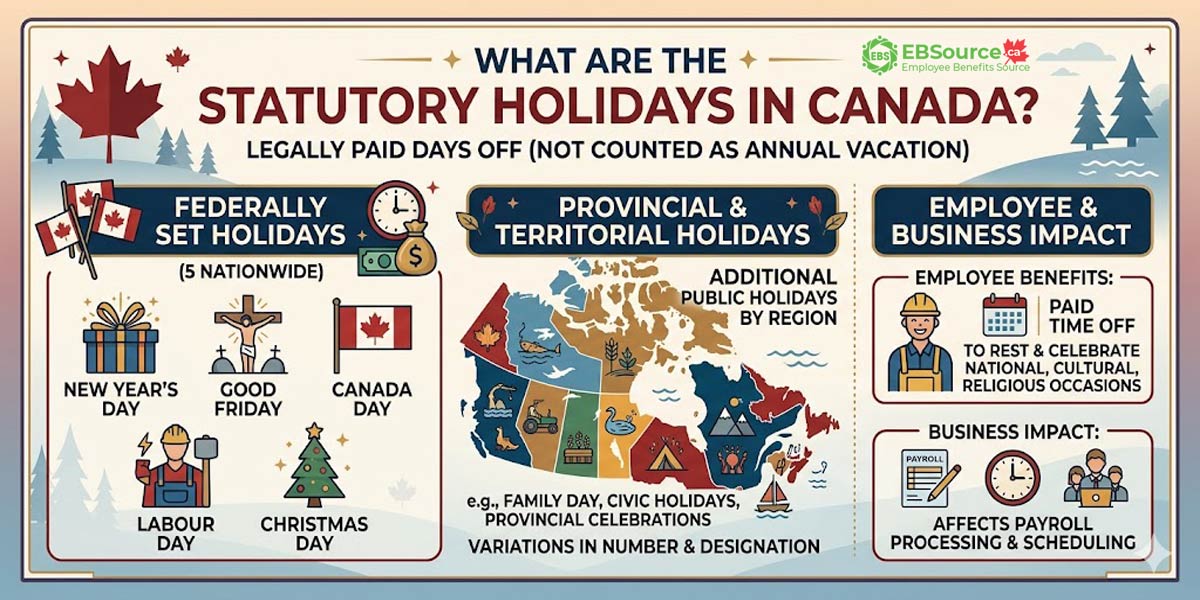
In Canada, statutory holidays, also known as “public” or “stat” holidays, are legally paid days off that are not counted as part of an employee’s annual vacation days.
As part of employee benefits, statutory holidays provide employees with paid time off to rest and celebrate national, cultural, or religious occasions. For businesses, statutory holidays impact payroll processing and scheduling.
The federal government sets five nationwide statutory holidays, and provinces and territories can mandate additional public holidays specific to their region. This results in variations in the number and designation of statutory holidays across the country.
Federal vs. Provincial Rules: Which Apply to You?
In Canada, employment laws, including statutory holiday entitlements, are divided between federal and provincial/territorial governments. The single most important factor in determining your holiday schedule is the industry you work in, not the province you live in.
Federal Rules Apply to You If You Work In:
Federal rules, governed by the Canada Labour Code, apply to a specific set of industries that operate across provincial borders or are under federal authority. If your job is in one of these sectors, you follow the federal holiday schedule regardless of your location.
Key federally regulated industries include:
- Banks, and federal credit unions are chartered under federal legislation.
- Transportation that crosses borders includes airlines, airports, railways, interprovincial trucking, and international shipping or ferry services.
- Telecommunications and Broadcasting, such as telephone, internet, cable, radio, and television companies.
- Federal Crown corporations and agencies, including Canada Post, the Canadian Broadcasting Corporation, and the Bank of Canada.
- Other sectors include postal and courier services, First Nations band councils, and industries like uranium mining and grain elevators.
Provincial or Territorial Rules Apply to You If:
You do not work in one of the federally regulated industries listed above. As a result, your workplace is regulated by the Employment Standards Act of its particular province or territory.
This distinction is crucial. For example, an employee at a bank in Toronto is federally regulated, while a person working for an accounting firm across the street is governed by Ontario’s provincial laws.
Because each province and territory sets its own list of statutory holidays, the days you get off can vary significantly. If you are unsure which system covers your workplace, you can consult your employer or the Government of Canada’s official list of federally regulated industries.
Source: https://www.canada.ca/en/services/jobs/workplace/federally-regulated-industries.html
Complete List of 2026 Statutory Holidays in Canada
Canada has five nationwide statutory holidays observed in every province and territory, plus several additional holidays whose observance depends on where you live and whether you work in a federally regulated industry.
Below is your guide to the 2026 holiday calendar, with the date for each holiday and a quick note on who observes it.
Nationwide Statutory Holidays
Five holidays are legislated as statutory in every Canadian province and territory: New Year’s Day, Good Friday, Canada Day, Labour Day, and Christmas Day. These are recognized across every province and territory, providing a paid day off for most workers, including:
New Year’s Day (Thursday, January 1, 2026): This marks the first statutory holiday of the year, legally recognized by both federal and all provincial/territorial governments.
Good Friday (Friday, April 3, 2026): Statutory in all provinces, territories, and under the Canada Labour Code. In Quebec, employers may give workers the day off on either Good Friday or Easter Monday.
Canada Day (Wednesday, July 1, 2026): Statutory in all provinces, territories, and under the Canada Labour Code. In Newfoundland and Labrador, July 1 is also observed as Memorial Day.
Labour Day (Monday, September 7, 2026): Statutory in all provinces, territories, and under the Canada Labour Code. This creates a standard three-day weekend.
Christmas Day (Friday, December 25, 2026): Statutory in all provinces, territories, and under the Canada Labour Code.
Additional Holidays by Jurisdiction
Beyond the five national holidays, all other statutory holidays are determined by provincial, territorial, or federal law. Because these jurisdictions set their own rules, a holiday that is mandatory in one area may be optional or not exist at all somewhere else.
As a result, the range of additional statutory holidays varies across jurisdictions, including:
Easter Monday (Monday, April 6, 2026): This is not a federal statutory holiday under the Canada Labour Code, but it is observed by many federal public service employers.
Victoria Day (Monday, May 18, 2026): Statutory in most provinces, all three territories, and under the Canada Labour Code. In Quebec, that same date is National Patriots’ Day. It is not legislated as a statutory holiday in New Brunswick, Nova Scotia, Prince Edward Island, or Newfoundland and Labrador.
Saint-Jean-Baptiste Day (Wednesday, June 24, 2026): A major statutory holiday in Quebec, but in 2026, it lands midweek, so it does not create an automatic long weekend unless you add vacation days.
Civic Holiday (Monday, August 3, 2026): The CRA lists this holiday as applying everywhere except Quebec, but its statutory status varies significantly across the remaining jurisdictions. It is a statutory holiday in British Columbia, New Brunswick, Saskatchewan, the Northwest Territories, and Nunavut. In other provinces like Alberta and Ontario, the day is widely observed but is considered an optional holiday.
National Day for Truth and Reconciliation (Wednesday, September 30, 2026): A statutory holiday for federal employees and workers in British Columbia, Northwest Territories, Prince Edward Island, and Yukon.
Thanksgiving Day (Monday, October 12, 2026): Statutory in most provinces, all three territories, and under the Canada Labour Code. Not statutory in the Atlantic provinces of New Brunswick, Nova Scotia, Prince Edward Island, or Newfoundland and Labrador.
Remembrance Day (Wednesday, November 11, 2026): Statutory under the Canada Labour Code and in most provinces and territories. Notable exceptions include Ontario and Quebec, where it is not a statutory holiday.
Boxing Day (Saturday, December 26, 2026): Boxing Day is a federal holiday and a statutory holiday in Newfoundland and Labrador and Ontario.
How Statutory Holidays in Canada Differ by Province and Territory
Every Canadian worker shares five nationwide statutory holidays: New Year’s Day, Good Friday, Canada Day, Labour Day, and Christmas Day.
Beyond that baseline, each province and territory adds its own statutory holidays and may classify certain federal holidays differently, creating wide variation across the country.
The table below details the additional statutory holidays that provinces and territories across Canada observe in addition to the five national holidays:
| Province/Territory | Total Holidays | Additional Stat Holidays |
| British Columbia Stat Holidays | 11 (5 National + 6 Provincial) | Family Day Victoria Day British Columbia Day National Day for Truth and Reconciliation Thanksgiving Day Remembrance Day |
| Alberta Stat Holidays | 9 (5 National + 4 Provincial) | Family Day Victoria Day Thanksgiving Day Remembrance Day Optional holidays: Heritage Day (first Monday in August) and National Day for Truth & Reconciliation (Sep 30) are legislatively designated optional holidays. Many employers also provide Easter Monday and Boxing Day. |
| Saskatchewan Stat Holidays | 10 (5 National + 5 Provincial) | Family Day Victoria Day Saskatchewan Day – First Monday in August Thanksgiving Day Remembrance Day |
| Manitoba Stat Holidays | 9 (5 National + 4 Provincial) | Louis Riel Day Victoria Day National Day for Truth and Reconciliation Thanksgiving Day Note: Terry Fox Day (first Monday in August) is a designated day but not a statutory holiday for pay purposes. |
| Ontario Stat Holidays | 9 (5 National + 4 Provincial) | Family Day Victoria Day Thanksgiving Day Boxing Day |
| Quebec Stat Holidays | 8 (5 National + 3 Provincial) | National Patriots’ Day St. Jean Baptiste Day Thanksgiving Day Note: Employers must observe either Good Friday or Easter Monday, not both. |
| New Brunswick Stat Holidays | 8 (5 National + 3 Provincial) | Family Day New Brunswick Day Remembrance Day |
| Nova Scotia Stat Holidays | 6 (5 National + 1 Provincial) | Heritage Day |
| Prince Edward Island Stat Holidays | 8 (5 National + 3 Provincial) | Islander Day National Day for Truth and Reconciliation Remembrance Day |
| Newfoundland and Labrador Stat Holidays | 6 (5 National + 1 Provincial) | Remembrance Day In addition, there are several unique observances, including: St. Patrick’s Day – March 17St. George’s Day – Monday nearest to April 23 Discovery Day – Nearest Monday to June 24 Regatta Day – First Wednesday in August Note: Newfoundland and Labrador observe Memorial Day on July 1 instead of Canada Day |
| Yukon Stat Holidays | 11 (5 National + 6 Provincial) | Victoria Day National Indigenous Peoples Day Discovery Day National Day for Truth and Reconciliation Thanksgiving Day Remembrance Day |
| Northwest Territories Stat Holidays | 11 (5 National + 6 Provincial) | Victoria Day National Indigenous Peoples Day Civic Holiday National Day for Truth and Reconciliation Thanksgiving Day Remembrance Day |
| Nunavut Stat Holidays | 11 (5 National + 6 Provincial) | Victoria Day Nunavut Day Civic Holiday National Day for Truth and Reconciliation Thanksgiving Day Remembrance Day |
Many regions observe similar days, but under different names, for example, Family Day, Louis Riel Day, and Islander Day, all fall on the third Monday in February. It’s essential for employers to clarify which specific statutory holidays apply based on their jurisdiction.
Which Holiday Rules Are Most Commonly Confused?
Even with a jurisdiction-by-jurisdiction table in hand, certain holiday rules trip up employers and employees year after year.
The confusion tends to cluster around a handful of recurring problem areas: holidays that look universal but are not (Good Friday vs. Easter Monday), holidays with different names in different provinces (the first Monday in August), and confusion about which legislative system applies (National Day for Truth and Reconciliation).
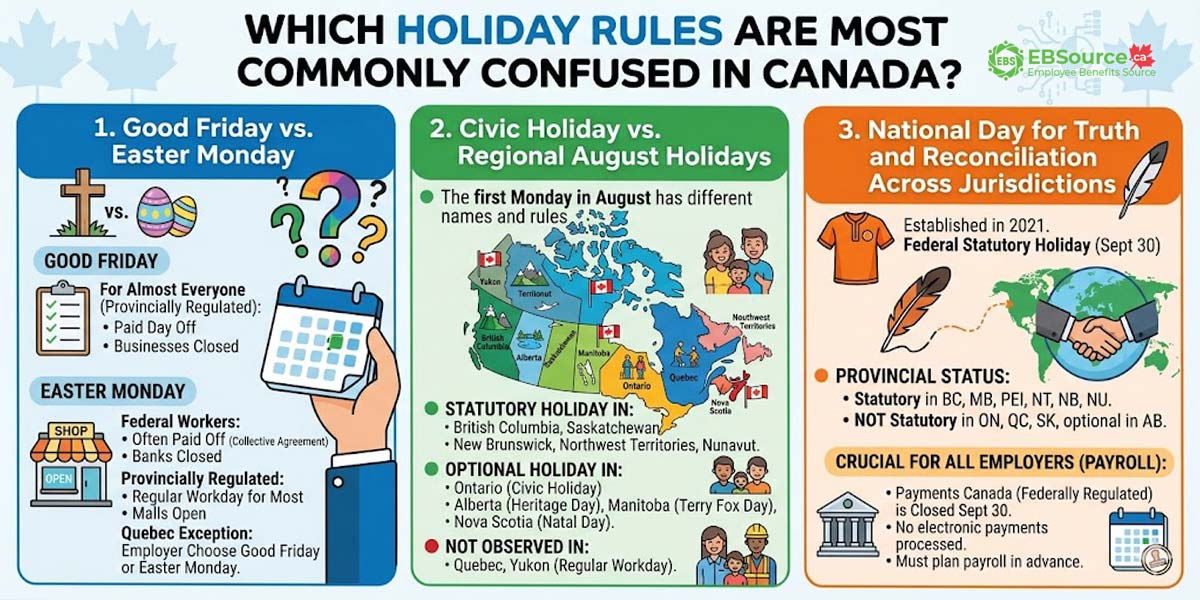
Below are the three areas we see confused most often:
Good Friday vs. Easter Monday
The Easter weekend is the single most misunderstood holiday period on the Canadian calendar. The confusion stems from a simple-sounding question: do I get Good Friday off, Easter Monday off, or both? The answer depends entirely on who your employer is and where you work:
- For Almost Everyone (Provincially Regulated): Good Friday is the statutory holiday. Businesses are closed, and you get a paid day off. Easter Monday is a regular workday for most. While schools and government offices often close, private-sector employers are not required to give you the day off.
- For Federal Workers: Good Friday is a statutory holiday. Easter Monday is also a paid day off for most federal employees, but it’s a perk from collective agreements, not a statutory holiday under the Canada Labour Code. This is why banks and federal offices are closed, while the mall next door is open.
- The Quebec Exception: Quebec is unique. Employers must provide a paid holiday on either Good Friday or Easter Monday, but they get to choose which one.
Important Note: Don’t assume you get both days off. For most Canadians, only Good Friday is a guaranteed paid holiday.
Civic Holiday vs. Regional August Holidays
The first Monday in August is another major point of confusion because it has different names and different rules across the country.
The day is a formal statutory holiday in British Columbia (B.C. Day), Saskatchewan (Saskatchewan Day), New Brunswick (New Brunswick Day), the Northwest Territories, and Nunavut (Civic Holiday).
For many others, it’s an optional day off (or Not Statutory):
- Ontario: It’s widely observed as the “Civic Holiday,” but it is not a statutory holiday. Whether you get it off depends on your employer.
- Alberta: Known as “Heritage Day,” it is also an optional holiday at the employer’s discretion.
- Manitoba & Nova Scotia: Observed as “Terry Fox Day” and “Natal Day,” respectively, but not official statutory holidays.
Also, the day isn’t observed at all in Quebec or Yukon, making it a regular workday. This can be a surprise for anyone moving between provinces, who might assume the day off is guaranteed everywhere.
The Real-World Impact: An employee moving from Vancouver (where B.C. Day is a paid holiday) to Toronto might be surprised to learn the Civic Holiday is not a guaranteed day off. So always check your local rules.
National Day for Truth and Reconciliation Across Jurisdictions
Established in 2021, this holiday is a federal statutory holiday, but its recognition across provinces and territories varies widely, as reflected in the following:
- It’s a Federal Statutory Holiday: All federally regulated employees have this day off.
- Provincial Status is a Mixed Bag: It is also a statutory holiday in British Columbia, Manitoba, Prince Edward Island, the Northwest Territories, New Brunswick, and Nunavut. However, it is not a statutory holiday in some of Canada’s most populous provinces, including Ontario, Quebec, and Saskatchewan. In Alberta, it’s an optional holiday.
A Crucial Detail for All Employers (Payroll):
Payments Canada, the national payment clearing system, is federally regulated and closes on September 30. This means no electronic payments are processed that day. Even if your business is in a province where it’s not a holiday, you must plan your payroll around this closure to ensure employees are paid on time.
How do Statutory Holidays in Canada Impact Payroll?
Statutory holidays have implications for payroll administration and scheduling for Canadian employers. Here are six key effects:
- Statutory holiday pay is calculated based on a percentage of the employee’s earnings in a specified period before the holiday. Different formulas apply across jurisdictions.
- Eligible employees receive a paid day off work for each statutory holiday and are still paid their regular wages for that day.
- Retail businesses staying open on stat holidays must pay eligible employees premium stat holiday pay in addition to their regular wages.
- Employers must determine employee eligibility for stat holiday pay based on factors like length of service and days worked.
- Adjustments are required to standard work weeks and schedules to account for statutory holidays.
- Stat pay must be processed accurately on payroll alongside regular wages and overtime.
Proper statutory holiday pay administration requires understanding the relevant provincial/territorial employment standards and having a payroll system capable of handling complex pay policies.
How Statutory Holidays and Group Benefits Interact
Although group benefits coverage remains uninterrupted, statutory holiday pay still plays an important role in plan administration, influencing how premiums are deducted, how income-replacement benefits are calculated, and how payroll and compliance are handled.
The key considerations are outlined below:
Premiums and Payroll Deductions
Statutory holiday pay is treated as regular earnings. As a result, all standard payroll deductions, such as employee-paid benefit premiums, income tax, CPP, and EI, are calculated and withheld as usual.
Indeed, this process ensures that funding for benefits and employee coverage continues uninterrupted during holiday periods.
Impact on Income-Replacement Benefits
When considering how your benefits and holiday pay interact, the most significant connection is with income-replacement plans like long-term disability.
The benefits you are entitled to are based on your pre-disability earnings, a calculation that includes your pay for statutory holidays. A key detail to be aware of is how extra pay for working on a holiday is treated. This depends on how the insurance provider defines “regular earnings” in your policy, so it is always best to check the policy documents to be certain.
Administrative Considerations
From an administrative perspective, several factors require attention, particularly when it comes to payroll timing, the treatment of insurable earnings, and Quebec-specific tax rules. Key details are outlined below:
- Payroll Timing: Bank closures on statutory holidays require payroll to be processed in advance. This adjustment can also shift the remittance date for benefit premiums. Although coverage is seldom disrupted, confirming deadlines with the insurer is a wise precaution, especially during periods with multiple holidays, such as late December.
- Insurable Earnings: Holiday pay is included in an employee’s insurable hours for EI and pensionable earnings for CPP. Including it maintains an accurate earnings history, which is crucial for calculating future claims or retirement income.
- Quebec-Specific Regulation: In Quebec, a specific regulation designates employer-paid premiums for health and dental plans as a taxable benefit to the employee. This tax treatment must be applied correctly during holiday pay periods to ensure accurate T4 statements.
FAQs related to Statutory holidays in Canada
[rank_math_rich_snippet id=”s-bdc3deda-dd1f-4774-87d9-8769cd93d72f”]
Article Sources