




For Canadian employers, managing employee benefits involves understanding different rules in each province, federal privacy laws, CRA reporting requirements, and bilingual obligations.
A right benefits administration provider handles complicated tasks for you. They help you make better choices about plan design, managing costs, and staying compliant with regulations.
This guide walks employers through the key evaluation criteria and a practical, step-by-step selection process to help you make a confident, well-informed decision.
Evaluation Criteria for Choosing a Benefits Administration Provider
To choose the right partner for managing employee benefit programs in Canada, organizations must conduct a complete evaluation based on service capabilities, compliance and regulatory expertise, technology and scalability, industry experience and client support, as well as pricing transparency, credentials, and financial stability.
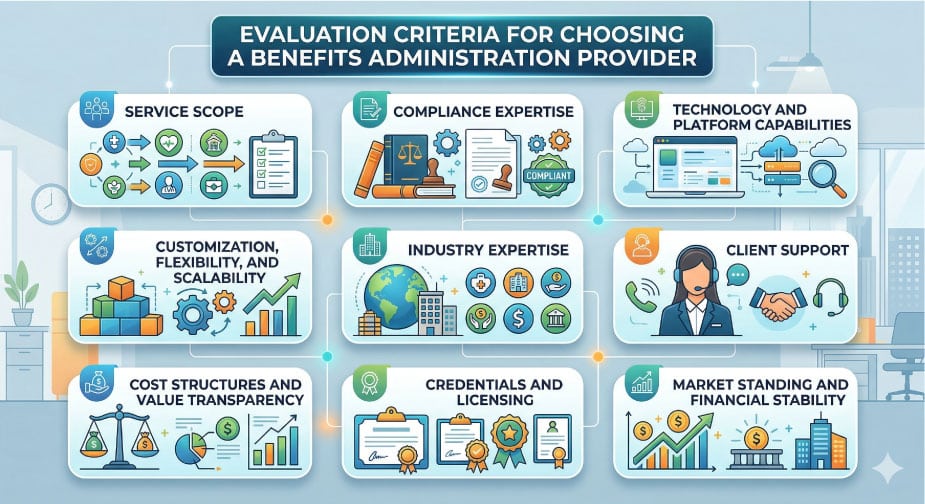
Below is a closer look at each of these factors and why they matter:
Scope of Services
Benefits administration providers vary widely in the services they offer. Some focus only on basic tasks, like processing enrollments, making reports, and issuing benefits cards. These tasks are standard and usually similar across different providers.
Others offer more valuable services, like helping design plans, supporting renewal negotiations, giving advice on tax-efficient funding, and providing usage reports. These services help employers manage costs over time and improve how well their plans work.
Compliance and Regulatory Expertise
Compliance expertise is essential in the Canadian benefits landscape. The Personal Information Protection and Electronic Documents Act (PIPEDA) establishes federal privacy requirements for private-sector organizations, while Alberta, British Columbia, and Quebec maintain their own privacy legislation that may apply instead, depending on jurisdiction.
Your service provider must also know the CRA rules for reporting taxable benefits. This includes calculating fair market value and making sure T4 reports are accurate. Good benefits administration providers stay updated on changes in legislation and support employers with compliance-related updates, rather than relying on employers to identify issues.
Technology, Integration, and Scalability
Technology plays a crucial role in making benefits administration easy or challenging for HR teams and employees. When choosing benefits platforms, focus on user experience, how well they integrate with other systems, their reporting features, and their overall flexibility.
Data security is also very important. Benefits platforms manage sensitive information, such as health data, Social Insurance Numbers, salary details, and dependent information. Ask providers about their encryption methods, access controls, procedures for notifying about breaches, and whether data is stored and processed in Canada.
The platform should also be scalable. As organizations grow, the system should support new plan designs, additional employee groups, and multi-province operations without requiring major changes.
Industry Expertise
Providers with experience in your industry understand common plan designs and claims patterns specific to your sector.
For example, technology companies may focus more on mental health support, while manufacturing industries often have union-related structures. Ask for references from organizations that are similar in size and location to see how the benefits administration provider deals with real-world issues.
Client Support
Client support is equally important. Determine whether you will have a dedicated account manager or use a general support queue. Confirm response times, escalation procedures, and support availability across provinces.
Some providers also assist with employee communications, onboarding materials, and ongoing education. These services improve employee understanding and reduce administrative workload.
Pricing Model and Transparency
Most benefits administration providers use one of three pricing models: per-employee-per-month (PEPM), percentage-of-premium, and flat retainer fees.
When choosing a provider, look at more than just the base fee. Some providers include plan design, renewal negotiation, compliance guidance, and employee communications in their base fee, while others charge extra for these services. Be aware that implementation, mid-year plan changes, reporting requests, and additional training can also lead to extra costs.
Credentials and Licensing
Look for important credentials in the account team. Professional designations show a commitment to understanding the Canadian market.
- CEBS/GBA/RPA: These are top credentials for benefits and retirement education.
- CLU: This indicates expertise in life insurance and wealth transfer.
- FCIA: This is necessary for providers that offer in-house actuarial services.
Make sure the benefits administration provider has valid licenses in each province where your employees live. You can check their status with provincial regulators like FSRA in Ontario, BCFSA in British Columbia, or AMF in Quebec.
Provider Stability and Financial Strength
Financial stability is an important consideration because benefits administration relationships are typically long-term. Switching benefits administration providers due to bankruptcy, acquisition, or operational disruption can be costly and time-consuming.
For small businesses, it is essential to review their ownership structure, years in operation, client retention rate, and whether they carry errors and omissions insurance. You can find financial data on federally regulated companies by checking the Office of the Superintendent of Financial Institutions (OSFI) website.
Practical Steps from Shortlist to Final Selection
Choosing a benefits administration provider is best approached as a five-step process. This process starts with gathering your internal needs, then moves to a structured evaluation, and ends with a finalized agreement that outlines clear service commitments.
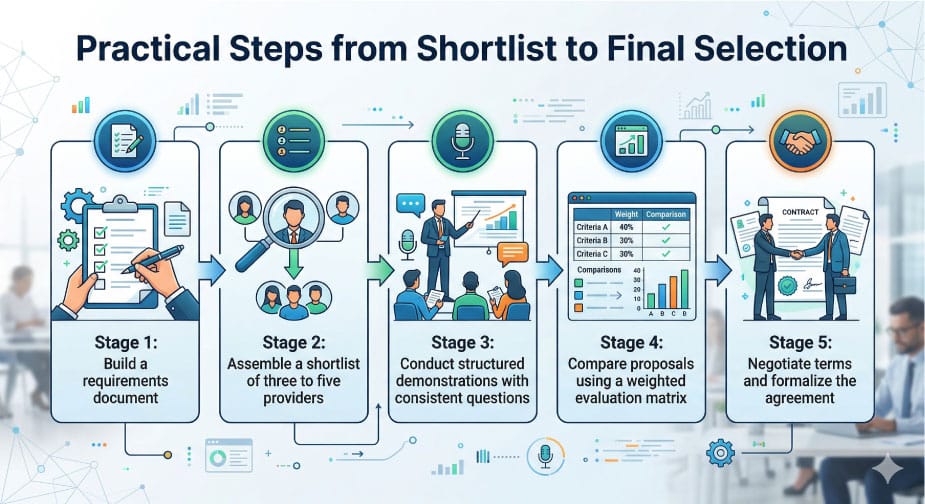
Here’s how each step in the process works and what you should focus on along the way:
Stage 1: Build a requirements document.
Before you reach out to any provider, create one document that outlines what your organization absolutely needs and what is nice to have. This should include:
- Number of employees and locations
- Benefits to be administered (health, dental, retirement, life, disability)
- Current HRIS and payroll systems
- Compliance or reporting requirements
A clear requirements document keeps demonstrations focused and ensures consistent proposals.
Stage 2: Assemble a shortlist of three to five providers.
Use the evaluation factors mentioned earlier in this guide to narrow down the wider market to a shorter list. Focus on providers who have experience in your industry and have worked with organizations of a similar size.
It is important to focus on Canadian-specific capabilities. Make sure that the providers you consider can support the provinces where your employees work and have active Canadian clients with similar needs.
Stage 3: Conduct structured demonstrations with consistent questions.
Use the same scenarios for each provider demo to compare capabilities consistently. For example:
- New hire enrolment
- Mid-year plan change
- Employee termination
- Payroll reporting for taxable benefits
Request references from Canadian clients of similar size and ask about implementation experience, support responsiveness, and compliance support.
Stage 4: Compare proposals using a weighted evaluation matrix.
Evaluate each benefits administration provider using the same criteria and a consistent scoring system. Make sure compliance and data security are significant parts of the overall score, based on your organization’s priorities.
When comparing costs, normalize all proposals to show a per-employee-per-month rate. This should include implementation fees spread out over the expected contract period.
If a proposal does not include costs for implementation, fees for changing carriers, or charges for custom reports, be sure to flag it. Missing this information can lead to unexpected expenses after you sign the contract.
Stage 5: Negotiate terms and formalize the agreement.
After choosing a preferred provider, negotiate the service agreement while focusing on Canadian requirements.
Make sure the contract clearly states what you need to do to comply with the Personal Information Protection and Electronic Documents Act (PIPEDA). Check the details about who owns the data, the service levels you should meet, and how to return the data.
Include an exit clause that allows for a 90-day transition period and full data export support. Before you sign, have a lawyer review the data residency, privacy, and liability terms. If your workforce is in Quebec, make sure it meets the requirements of Law 25.
Special Considerations for Specific Canadian Employers
Certain employer profiles have extra challenges that standard evaluation criteria may not cover completely. This includes issues like language requirements, operating in multiple provinces, managing data security, and changes in service providers.
Bilingual Platform and Communication Requirements
Employers in Quebec must provide services in both English and French to comply with the Charter of the French Language.
Even outside Quebec, bilingual benefits administration platforms are often needed for organizations with national policies or bilingual employees. These platforms help ensure fair access and clear communication.
Managing Benefits Administration Across Multiple Provinces
Employers with employees in multiple provinces need a benefits provider that can follow the specific rules of each area. During evaluation, test this capability using real scenarios.
For example, ask the provider to show how their system handles the following three cases:
- An employee moving from Ontario to British Columbia mid-year
- Updates to provincial health coverage eligibility and waiting periods
- Adjustments to supplementary benefits during the transition
Scenario-based testing reveals actual system capabilities better than feature lists alone.
Data Residency and Security
Choosing a provider without clear rules on where data is stored can lead to security risks, problems with regulations, and disputes in contracts.
When evaluating a provider, ask the following:
- Where are primary and backup servers physically located?
- Does any subprocessor or third-party integration transfer data outside Canada, even temporarily?
- What remedies are available if data residency commitments are not met?
Make sure to include these requirements in the service agreement. Don’t rely on marketing claims or informal promises.
When to Reassess or Switch Providers
Reassess your provider when their capabilities no longer align with your organization’s evolving needs, compliance requirements, or growth plans. When planning a transition, a structured approach helps reduce disruption:
- Secure your data early.
- Time for the transition with benefits cycles.
- Allow enough time for the transition.
- Communicate clearly with employees.
A well-planned transition reduces risk and helps maintain continuity in employee benefits and reporting.
