




Choosing an EAP provider for small businesses requires focusing on three core decisions: what support your employees actually need, how the program will be priced, and which provider can deliver reliable, accessible services. These factors determine whether the program will be used in practice and whether the cost remains sustainable.
For Canadian small businesses, making the right choice also carries operational and compliance implications. A well-matched Employee Assistance Program (EAP) reduces absenteeism, strengthens retention, and helps meet the duty-of-care expectations embedded in the Canada Labour Code and provincial occupational health and safety legislation.
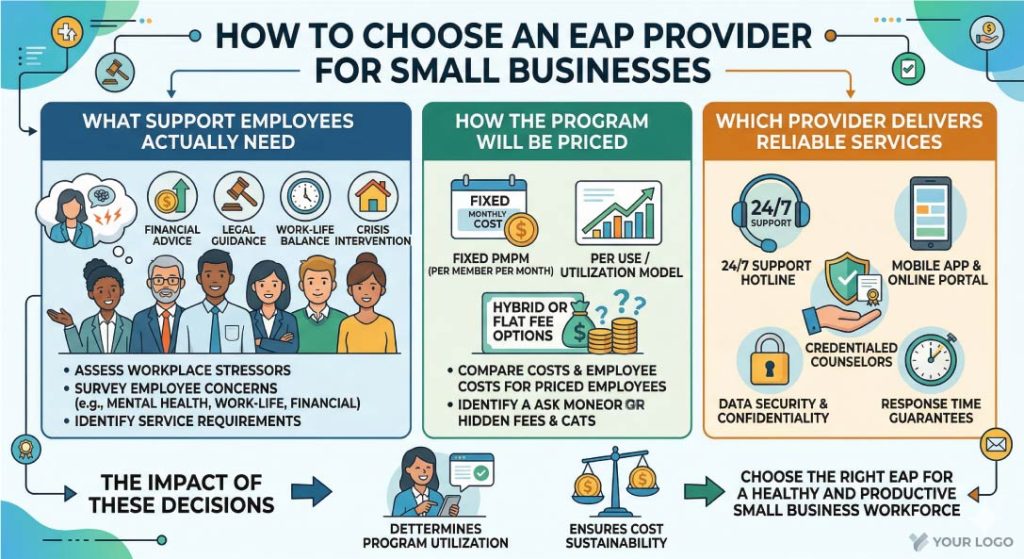
Step 1: Identify the Type of EAP Support Your Employees Need
The first step is to clearly define what kind of support your employees actually need. This ensures you are not just choosing a provider with the most features, but one that delivers meaningful value for your team.
Most EAP providers offer a similar range of services, including: counselling services, legal aid, financial guidance, crisis intervention, wellness resources, and managerial consultation. These services align with standard EAP offerings outlined by the Canadian Centre for Occupational Health and Safety. However, the depth, delivery method, and accessibility of these services can vary significantly.
To make an effective comparison later, it is important to understand each category of support and how it applies to your team’s day-to-day challenges.
Counselling services
Counselling services typically include short-term sessions for stress, anxiety, burnout, family conflict, and relationship difficulties. Depending on the provider, sessions may be available in person, by video, by phone, or through text-based chat.
Legal aid
This service helps employees connect with qualified legal experts for advice on issues like tenant disputes, family law, estate planning, and immigration questions. Most providers offer a free initial consultation, which makes it easier for employees to get the help they need.
Financial guidance
Financial guidance connects employees with advisors who can help with budgeting, debt management, and basic retirement planning because financial stress is one of the leading drivers of workplace distraction and absenteeism.
Crisis intervention
Crisis intervention provides around-the-clock support lines for urgent mental health situations, critical workplace incidents, or bereavement. Employees can reach a trained professional at any hour, something that matters especially for small businesses without an internal crisis response team.
Wellness and work-life balance
Preventive resources such as mindfulness tools, sleep programs, nutrition guidance, and stress-management workshops. These proactive offerings support employee well-being before issues reach a clinical threshold and tend to drive higher ongoing engagement with the program.
Managerial consultation
This service provides coaching and resources for managers on supporting team well-being, handling difficult conversations, and recognizing early warning signs of employee distress. For small businesses where managers often lack formal HR training, this service fills a critical gap.
Step 2: Choose the Right EAP Pricing Model for Your Budget
After defining your employees’ needs, the next step is to set a budget and choose a pricing model. The model you choose will determine not only your monthly cost, but also how confidently you can promote the program to employees without worrying about unpredictable expenses.
The four common pricing models are per-employee-per-month (PEPM), pay-per-use, inclusive-session packages, and flat-rate digital access, each balancing predictability against cost control.
The following table compares the four pricing structures most commonly offered to small businesses.
| Pricing Model | How It Works | Best Suited For |
| Per-employee-per-month (PEPM) | Fixed monthly fee per enrolled employee; scales with headcount | Businesses wanting predictable budgeting and broad access |
| Pay-per-use | Annual retainer or subscription plus a fee each time an employee uses a session | Very small teams with uncertain utilization; lower upfront cost |
| Inclusive-session package | Fixed fee includes a set number of sessions per employee per year, typically two, three, or five | Businesses that want to promote usage without worrying about per-session costs |
| Flat-rate digital access | Single subscription for a digital platform with self-guided content, AI tools, and limited live sessions | Budget-conscious businesses prioritizing preventive wellness over clinical depth |
PEPM and inclusive-session models offer the most predictable costs and make it easier to promote the program internally without concern about runaway expenses. Pay-per-use, sometimes called pay-as-you-go, suits very early-stage businesses that want to test the concept before committing.
A pay-per-use model may discourage managers from promoting programs because each session costs money. To avoid this issue, businesses should set a clear annual budget limit and share it with employees. This way, cost concerns won’t hold back promotion efforts.
Step 3: Evaluating an EAP provider Against Critical Factors
The last step is to understand what factors to compare when evaluating EAP providers, including accessibility, the range of services offered, confidentiality, clinical qualifications, reporting, cultural and language compatibility, and the ability to grow with your business.
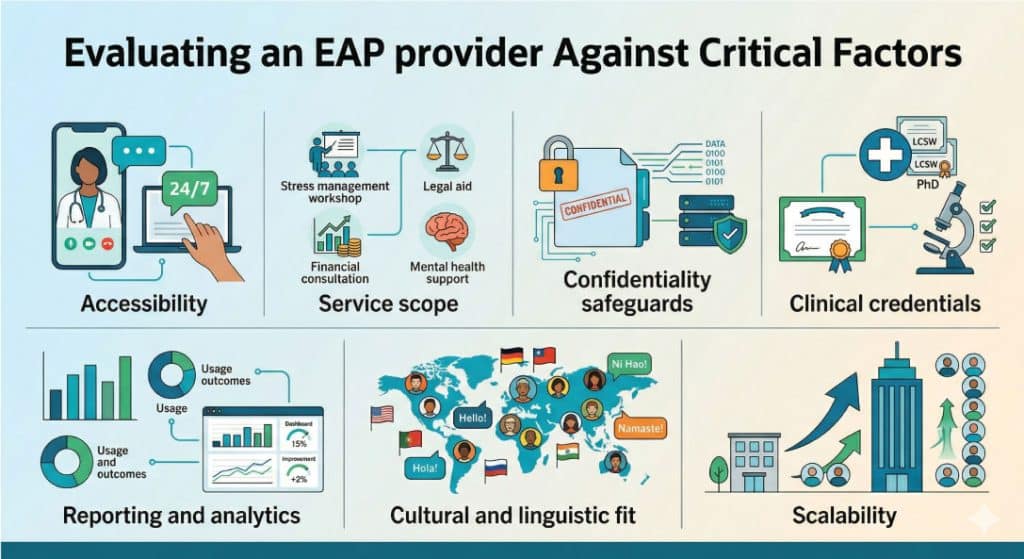
By evaluating each of these factors before signing a contract, you can lower the risk of picking a provider who seems good on paper but doesn’t perform well in reality.
Accessibility
Support should be available around the clock through multiple channels, including phone, video, chat, and app. Ask whether employees can book an appointment within 24 hours of requesting one. If the team includes remote or hybrid workers, confirm that virtual-first delivery is a core offering rather than a secondary option.
Service scope
The provider should cover counselling, legal guidance, financial advice, and crisis intervention as standard services. Check whether wellness and work-life resources, such as stress-management tools or sleep programs, are included in the base fee or cost extra.
Confidentiality safeguards
Employees will not use a program they do not trust to keep their information private. Ask the provider to explain its data-handling policies, where employee records are stored, and what aggregate usage data, if any, is shared with the employer.
In Canada, this should be assessed within a defined legal framework. At the federal level, the Personal Information Protection and Electronic Documents Act (PIPEDA) sets out requirements for how private-sector organizations collect, use, and safeguard personal information.
Privacy requirements may also vary by province. Jurisdictions such as Alberta and Quebec have their own private-sector privacy laws, which can impose additional compliance obligations. (Source)
Clinical credentials
Verify that counsellors or psychologists delivering services are registered with recognized Canadian professional bodies such as provincial colleges of psychologists or colleges of social workers. Ask whether the provider relies on an in-house clinical team or an external affiliate network, and how clinical quality is monitored over time.
Reporting and analytics
Look for anonymized utilization reports, trend data, and satisfaction metrics delivered on a regular schedule. These allow the business to measure whether the investment is producing results and to adjust well-being initiatives accordingly. A provider that offers a real-time reporting dashboard makes it easier to track engagement without waiting for quarterly summaries.
Cultural and linguistic fit
Canada’s workforce is diverse in language and culture. First, make sure the provider offers services in both English and French. Ask if they offer additional languages and if their counsellors are trained to provide culturally informed care. Connecting employees with counsellors who understand their cultural background can help reduce stigma and encourage them to use the program.
Scalability
The provider should accommodate growth without requiring a full contract renegotiation. Ask how pricing tiers and service levels change as headcount increases. If the business plans to grow from 10 to 50 employees over two to three years, the provider’s model should support that trajectory without forcing a disruptive mid-contract switch.
Evaluating these factors thoroughly will help you determine which EAP model best aligns with your company’s specific needs. Generally, EAP providers for small businesses in Canada fall into two primary categories: digital-first platforms and more clinically integrated options. Depending on your priorities, you may explore providers such as Inkblot Therapy or established names like Homewood Health and TELUS Health.
Questions to Ask an EAP Provider Before You Sign
Before committing to a contract, prepare a focused list of questions that force each prospective provider to be specific about service delivery, cost, and accountability. They are split into two groups: service and access, then cost and accountability.
About Service and Access questions:
- How quickly can an employee access a counsellor after initial contact?
- What channels are available (phone, video, chat, app, in-person)?
- Are all clinicians registered with a Canadian professional regulatory body?
- What services are included in the base package versus billed as extras?
About cost and accountability questions:
- What is the all-in cost per employee, including any surcharges or add-ons?
- Will the price change based on actual utilization over the contract term?
- How often are anonymized utilization and satisfaction reports delivered?
- Can the plan be scaled up, down, or cancelled if business needs change?
Make an extra effort to ask for references from businesses that the provider hasn’t shared, especially those like yours in size or industry. Independent references will give you better insight into how the program works in real life than any sales presentation.
FAQs about How to Choose an EAP Provider for Small Businesses
[rank_math_rich_snippet id=”s-02987fdd-468a-42e1-8075-cbf1aec7e866″]
